

A macadam tennis court drains quickly after rain, stands up to heavy use, and stays playable throughout the British seasons without taking your facility out of action. It's the surface you'll find on most school, club, and private courts across the UK - and there's a reason for that.
Whether you manage a club, run a school with outdoor courts, or own a private tennis court, understanding what macadam hard courts offer and what they need will help you get the most from your investment. This page covers it in full: how it's built, how it plays, how long it lasts, and what happens when it starts to show its age.
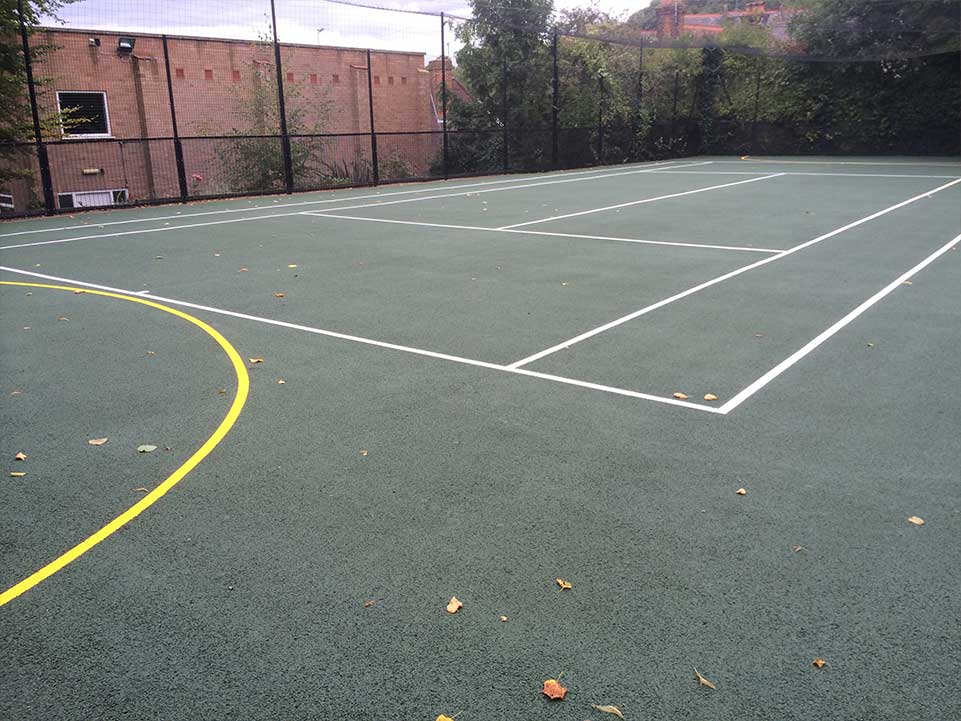
Hard Tennis Courts and multi-use games areas (MUGAs)
- Easily identified by a hard Tarmac style or Rubberised (Polymeric) painted surface
- Can be painted or unpainted
- A variety of lines can be added for true multi-sport
- Ideally suited to Tennis, Netball, Basketball
Looking for maintenance on your Tarmac Hard Court/MUGA surface?
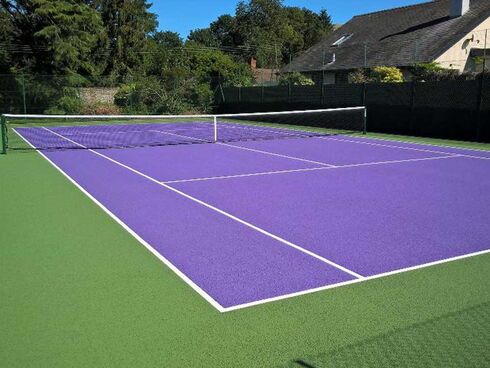
What Is A Macadam Tennis Court And Why Is It Britain's Most Common Hard Court?
A macadam tennis court is built on open-textured tarmacadam - a bound, bitumen-based material that creates a stable, level playing surface. The key difference from road tarmac is the texture: the aggregate is graded to leave small voids throughout, allowing water to pass through rather than pool on top.
Is Tarmac Permeable? How A Macadam Court Handles Rain
Standard road tarmac isn't permeable - water sits on the surface until it runs to the edges or evaporates. A macadam tennis court is different. The tarmac used for sports courts is open-textured, permeable tarmac - designed specifically so rainfall passes through the surface rather than across it.
This matters because porous macadam drains freely after heavy rain, so the court is typically ready to play on far sooner than a non-porous surface. Water moves vertically through the material and away into the sub-base below instead of waiting to sheet off the edges.
So yes - tarmac can be permeable, but only with the right open-textured specification. A macadam tennis court built correctly will drain efficiently in all but the most severe downpours. Left poorly maintained, the pores can become blocked by compacted debris, algae, or moss - which is why periodic pressure washing and chemical treatment keep drainage working as it should.
How A Macadam Court Plays: Speed, Bounce And Ball Behaviour
A macadam court plays at medium to medium-slow speed, which suits most recreational and club players. The ball bounces at a consistent height with a predictable trajectory - true enough for players of all standards to read and respond to comfortably. It's not as fast as a non-porous hard court, or as slow as clay.
The surface responds well to topspin. The textured finish from the acrylic colour coat over the macadam base provides enough grip for topspin shots to bite and kick, making it good for players working on shot shape. Slice shots skid lower than on clay but still have effect.
Underfoot, the surface is firm. Footing is reliable and non-slip when the court is clean and the colour coat is in good condition. As the acrylic wears and moss or algae takes hold, grip reduces - one of the clearest reasons to keep the surface treated and maintained. A well-kept macadam court is safe and comfortable to play on in normal weather.
For further information go to Download Macadam Hard Courts Surface Sheet.




Download Macadam Hard Courts Surface Sheet
For further information call 01354 654422 or get a quote today.
How Long Does A Macadam Tennis Court Last?
A macadam tennis court base is a long-lived structure. The sub-base and bound macadam layer remain structurally sound for decades when properly installed and drained. The wearing surface - the acrylic colour coat - needs periodic attention, typically needing a recoat every five to eight years, depending on usage intensity and exposure years, depending on how heavily the court is used and how well it's been maintained between applications.
Courts that receive regular cleaning, moss and algae treatment, and timely recoating stay fully playable for 15 years or more before structural work is needed. Courts with no maintenance show significant cracking, surface degradation, and drainage failure much earlier - what could have been a recoat becomes an expensive resurfacing project.
Usage level, shade, drainage quality, and maintenance frequency all influence how your court ages. A free site assessment will tell you honestly where your macadam court stands and what's needed to keep it performing well long-term.
Most macadam tennis courts across the UK are finished with an acrylic colour coat applied over the macadam base. The macadam layer handles drainage and structure; the colour coat handles how the court looks and plays.
It dominates UK tennis provision because it balances cost, durability, and ease of maintenance well. It costs far less to install than a cushioned acrylic surface, and requires significantly less specialist care than natural grass. For most facilities, a macadam court is the practical choice.
What Maintenance Does A Macadam Hard Court Need To Stay Playable?
Macadam is often called low-maintenance - and compared to natural grass or clay, that's fair. But low-maintenance doesn't mean no maintenance. Left unattended through autumn and winter, moss and algae spread across the surface, debris blocks the drainage pores, and what could have been a simple treatment becomes a resurfacing project.
The core tasks a macadam hard court needs are straightforward. A seasonal or annual deep clean - pressure washing and professional biocidal treatment like AlgoClear Pro - removes moss and algae at the root and keeps drainage clear. Regular debris clearance between professional visits prevents organic matter compacting the surface.
The acrylic colour coat needs checking annually. When it wears unevenly, fades noticeably, or shows reduced grip, recoating is due - catching this before the surface beneath is exposed saves significant cost. Courts with heavy shade or poor drainage need more frequent professional attention than those in open, well-drained locations.
For a full overview of the treatments, visit our tennis court maintenance page.
Macadam As A Base For Acrylic Coating: How The Two Work Together
Most macadam tennis courts in regular use are not bare tarmac - they have an acrylic colour coat applied over the macadam base. The two materials serve different purposes, and understanding how they work together helps you make better decisions about maintenance and restoration.
The macadam layer provides the structural base: it gives the court its shape, drainage, and long-term stability. The acrylic coat sits on top and provides the playing surface: colour, texture, traction, and ball response. When the acrylic wears or cracks, the macadam beneath is usually still sound - which means restoration often means recoating rather than replacing the base.
This is also why a macadam court is a practical starting point for clubs or owners who later want to upgrade. A sound macadam base can be overcoated with a cushioned acrylic system, converting the court to a more resilient surface without the cost and disruption of a full base rebuild.
For more on the colour coat and recoating, see our acrylic tennis court page.
Macadam Courts For Schools, Clubs And Private Owners: Which Situations Suit It Best
Macadam isn't right for every situation, but it suits most. Knowing where it performs best helps you assess whether it's the right choice for your facility or property.
-
Schools and multi-sport facilities. A macadam base is the standard foundation for a MUGA - a multi-use games area combining tennis, netball, basketball, and sometimes football on one court. It handles high footfall, mixed-sport wear, and the year-round intensity of a school environment. It's also cost-effective when multiple courts need to be built within a set budget.
-
Tennis clubs. For a club running regular sessions and needing courts playable after rain with minimal delay, a well-maintained macadam court with sound acrylic finish is reliable. It doesn't have the cushioning of a premium system, but it delivers consistent performance at lower long-term cost.
-
Private court owners. If you're installing or restoring a private court and want a surface that is durable, easy to maintain, and significantly less expensive than alternatives, macadam is worth serious consideration. Courts used at moderate intensity by recreational players stay in excellent condition for many years with annual professional maintenance.


Macadam, Tarmac And Asphalt: Understanding The Terminology
If you've searched for information about your court and found the terms macadam, tarmac, tarmacadam, and asphalt used interchangeably, you're not alone. In sports courts, these all describe the same category of material - a bound, bitumen-based surface - and are used without distinction across the industry, in quotes, and in planning documents.
Technically, macadam refers to a layered aggregate method, and tarmac (short for tarmacadam) is macadam bound with tar or bitumen. Asphalt tennis courts and tarmac tennis courts are the same product described differently. What matters is not which term appears on your quote, but the specification: the aggregate size, the open texture that allows drainage, and the quality of installation and sub-base.
Throughout this page, we use macadam and tarmac interchangeably because that's how the market speaks. If a quote refers to a tarmac court, macadam court, or asphalt surface - they're the same thing. The questions worth asking are about drainage specification, sub-base depth, and what colour coat is being applied on top.
Resurfacing And Rejuvenation Options For An Ageing Macadam Court
An ageing macadam court is rarely beyond recovery. The range of interventions available - from a targeted recoat through to full resurfacing - means there's almost always a viable, cost-effective option short of starting from scratch. The right approach depends on the condition of the base, the extent of wear, and your budget and timescale.
For courts where the macadam base is sound but the acrylic finish has worn, a clean, prime, and recoat is typically most cost-efficient. It restores playing quality, grip, and appearance at a fraction of full resurfacing cost, and - carried out at the right point - adds significant years to the court's life.
Where cracking has let water into the base, or where the macadam has suffered movement or drainage failure, more comprehensive work is needed. This may involve crack repair and stabilisation before recoating, or in more severe cases a full structural resurfacing. Even courts that look beyond saving can often be restored without a complete base rebuild - but professional assessment is the only reliable way to know which category your court falls into.
We provide honest, itemised quotations after a free site visit, so you know exactly what the work involves and why before committing to anything. For full detail on resurfacing and installation options, see our resurfacing tennis court page.
Macadam, Tarmac And Asphalt: Understanding The Terminology
If you've searched for information about your court and found the terms macadam, tarmac, tarmacadam, and asphalt used interchangeably, you're not alone. In sports courts, these all describe the same category of material - a bound, bitumen-based surface - and are used without distinction across the industry, in quotes, and in planning documents.
Technically, macadam refers to a layered aggregate method, and tarmac (short for tarmacadam) is macadam bound with tar or bitumen. Asphalt tennis courts and tarmac tennis courts are the same product described differently. What matters is not which term appears on your quote, but the specification: the aggregate size, the open texture that allows drainage, and the quality of installation and sub-base.
Throughout this page, we use macadam and tarmac interchangeably because that's how the market speaks. If a quote refers to a tarmac court, macadam court, or asphalt surface - they're the same thing. The questions worth asking are about drainage specification, sub-base depth, and what colour coat is being applied on top.
Get A Free Assessment For Your Macadam Tennis Court
Whether your macadam court needs a seasonal clean, a recoat, or a full structural assessment, the right starting point is a free site visit. We come to you, look at the surface, and tell you honestly what it needs - and what it doesn't.
There's no obligation and no pressure. You'll receive a clear, itemised quotation and a straightforward explanation of what the work involves and why. We work around your facility's calendar, scheduling visits and work to minimise disruption to players and bookings.
We cover Cambridgeshire, East Anglia, and the wider UK. Hard court tennis is what we do - and a free assessment is the fastest way to find out what your court needs to perform well and last longer. Get in touch today to book yours.