

Tennis Court Surfaces:
Which Is Right for Your Court?
Choosing the right surface matters. Get it right and you have a playing facility that performs well for fifteen years or more, stays usable through a British winter, and is something your members, pupils or family genuinely enjoy. Get it wrong and you face poor drainage, an unsuitable playing speed, or a surface that costs more to maintain than it should.
This page covers the main tennis court surfaces used in the UK - porous macadam, acrylic, and artificial grass - explaining how each one plays, who it suits, what it costs to install and maintain, and how long it is likely to last. If you already know what you are looking for, use the sections below to navigate straight to the surface type that interests you.
Get Help With Artificial tennis court grass
What The Right Surface Actually Means for Your Court

A surface that drains badly will stay wet after rain, become slippery, and deteriorate faster than one properly matched to the site. A surface that plays too fast for recreational players will discourage use. A surface specified without considering maintenance will be neglected, and its life will shorten significantly.
Our role is to help you make the right call before any work begins. The sections below set out what each of the main tennis playing surfaces actually delivers, so you can compare them on the things that matter to your decision.
Seasonal maintenance costs a fraction of early resurfacing. Done regularly, surface treatment is manageable, effective and the single best way to extend the playable life of your court. We work across grass courts, synthetic and astro turf tennis courts, hard courts and artificial clay, so whatever surface you have, we can help you look after it properly.
The sections below cover each surface type in turn - what it needs, what happens when it is neglected, and what we can do to put it right.
There are three principal types of tennis court surfaces installed on UK courts: porous macadam hard courts, acrylic coatings applied over a macadam base, and artificial grass. Natural grass courts exist at a small number of private estates and established clubs, but they are rare and expensive to maintain to a playable standard. For the vast majority of clubs, schools, and private owners in the UK, the choice sits between the three main categories below.
Each surface has a genuinely different playing character, maintenance requirement, and installation cost. The sections that follow cover each one in plain terms, so you can compare them honestly before making any decision.



Porous Macadam Hard Courts
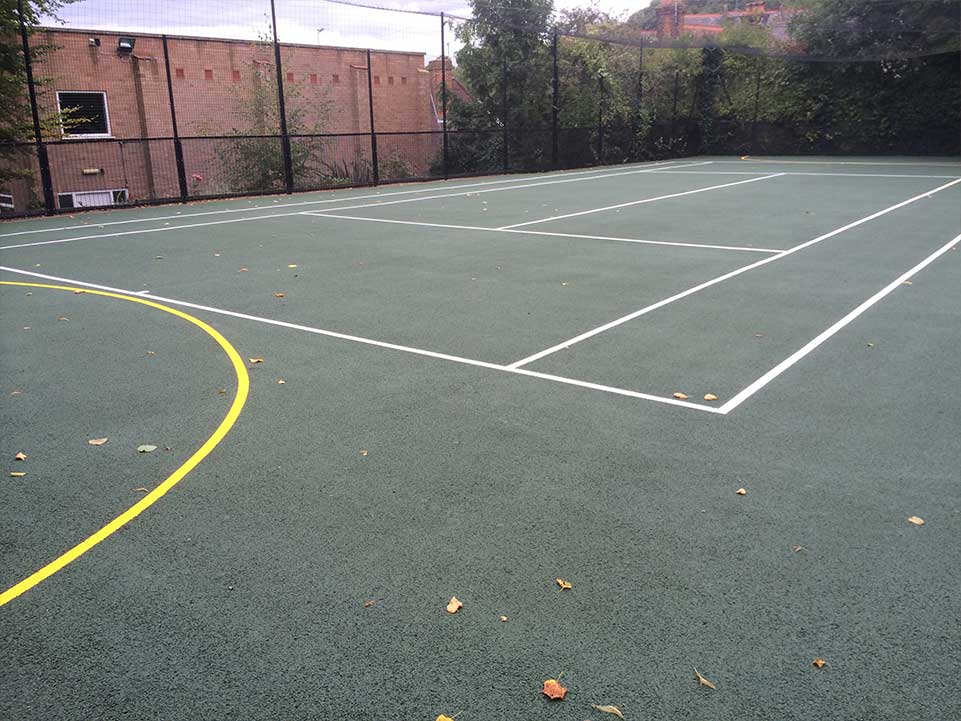
A porous macadam court is built from an open-textured, tarmac-derived base that lets rainwater drain straight through rather than pooling on the surface. It is the most common type of court in the UK - you will find them at most council parks, schools, and domestic properties. They are popular because they are relatively cost-effective to install, drain well after rain, and provide a consistent, medium-paced playing surface with good underfoot grip.
Left unpainted, a macadam base is functional but plain. Most courts have a coloured surface layer applied over the top, which is where acrylic coatings come in. A well-built macadam court, properly maintained, can remain playable for 15 years or more. The main maintenance tasks are moss and algae control, crack repair, and periodic re-coating as the surface layer wears.
For detailed information on construction, specification and costs, visit our hard tennis courts page.
Acrylic Tennis Court Surfaces
An acrylic coating is the coloured, textured layer applied over a macadam base to create the playing surface seen on most UK outdoor hard courts. It gives the court its colour - traditionally red and green, though blue tennis court finishes have become increasingly common - and provides the textured grip that makes hard courts playable in wet conditions. The acrylic layer also affects ball speed: a coarser texture slows the ball; a finer one plays faster.
Over time, the acrylic colour coat fades, cracks appear, and traction reduces. Re-coating restores grip, drainage and appearance at a fraction of the cost of rebuilding the base. Even courts that look badly worn may need nothing more than a professional clean, crack repair, and a fresh colour coat to play as well as they did when new.
For full details on acrylic surface specification, colour options and costs, see our acrylic tennis court surface page.
For further information go to macadam hard courts.
Artificial grass for tennis courts has improved considerably over the past two decades. Modern tennis court turf is a different proposition from the coarse, unforgiving carpets of earlier generations. Today's synthetic surfaces offer consistent ball bounce, good drainage, and a playing experience that suits recreational players of all ages and abilities.
There are two main variants used on UK tennis courts. A sand-dressed surface uses a fine layer of sand brushed into the fibres, leaving most of the pile exposed. It plays a little like a grass court, with a slightly lower, skiddy bounce. A sand-filled surface has sand packed up to the fibre tips, making it more durable under heavy use and better suited to multi-sport courts where the same surface is used for netball, basketball, and five-a-side football as well as tennis.


Both variants drain freely after rain and can be used year-round. For clubs and schools that cannot afford a court to sit unused through a wet autumn, that reliability matters. For detailed information on construction, specification and installation, visit our artificial grass tennis court page.
How Artificial Grass Tennis Courts Play
The playing character of an artificial grass court sits somewhere between a natural grass court and a hard court. Ball bounce is lower and the surface plays faster than a macadam hard court, which suits players who rely on flat, attacking ground strokes. The slight give underfoot reduces joint stress compared to a rigid acrylic or macadam surface - something worth considering for older club members or regular recreational players.
Court speed varies depending on the infill level. A sand-dressed surface plays faster, with a lower, skiddier bounce. A sand-filled surface plays a little slower and more consistently, better for players who prefer a predictable rally game. Neither variant suits heavy t
What Type of Grass for Tennis Court is Best?
On a modern synthetic tennis court grass surface, the fibres are manufactured from either polypropylene or polyethylene. Polypropylene is stiffer and harder-wearing, making it well suited to high-traffic club courts. Polyethylene is softer underfoot and has a more natural feel, which tends to suit private and domestic courts where playing comfort matters as much as durability.
Pile height - the length of the synthetic fibres - is typically between 20 mm and 25 mm for tennis. A shorter pile with more infill plays faster and harder; a longer pile with less infill plays slower and softer. The right combination depends on how the court will be used, who will play on it, and how much maintenance you want to carry out each season. We assess each court individually and recommend the fibre type, pile height and infill level that fits your situation.
Artificial Grass versus Natural Grass: What Changes on Court
Natural grass - the surface played on at Wimbledon - is fast, low-bouncing, and unpredictable. It rewards players who attack and punishes those who rely on heavy topspin. It is also expensive and labour-intensive to maintain: a natural lawn tennis court needs mowing, rolling, seeding, watering, and resting through the playing season. Even well-maintained grass courts are unusable in wet weather and deteriorate quickly under heavy use.
Grass court tennis at club or private level is a real but niche choice. For most UK facility managers and private owners, synthetic tennis court grass delivers the playing character of a grass surface without the maintenance burden. It is usable year-round, drains freely after rain, and does not require resting or reseeding. The playing speed is similar to a sand-dressed natural grass court; the bounce is slightly more consistent. For most purposes, that is a trade worth making.
All our staff are enhanced DBS checked and are trusted by us to work in private homes across East Anglia.
The difference between grass and hard court tennis goes beyond aesthetics. Each surface produces a genuinely different game. Hard courts - whether macadam or acrylic - play at a medium pace with a higher, more predictable bounce that rewards baseline rallying and consistent ground strokes. Grass courts, natural or synthetic, play faster with a lower, skiddier bounce that rewards serve-and-volley play and flat attacking shots.
For players moving between different tennis surfaces, the adjustment is real. A ball that sits up on a hard court will skid through low on grass. Footwork patterns change, particularly on approach shots and at the net. At recreational level, these differences are manageable, but they are worth understanding when choosing a surface that will suit the majority of players who use your court.
Maintenance and durability differ too. Hard courts are robust and relatively forgiving of infrequent maintenance. Grass courts - even synthetic ones - need more regular brushing to keep the pile upright and the infill level. The sections below map these tennis court surface differences to the factors that matter most for your decision.


How Ball Bounce and Court Speed Differ by Surface
On a porous macadam court, the ball bounces high and true. The firm, consistent surface rewards baseline players and is forgiving of slight imperfections in timing. Court speed is medium, making it reliable for club leagues, coaching, and recreational play across a wide range of abilities.
An acrylic coat applied over macadam modifies that playing character slightly. A coarser acrylic texture slows the ball and increases grip; a finer texture produces a faster, slicker surface. This gives clubs some control over how their court plays - useful where the same court is used for coaching beginners and competitive club matches on alternate days.
Artificial grass plays faster than acrylic, with a lower bounce and slightly more slide. Among the different types of tennis court surfaces available in the UK, it is the one that most closely approximates the feel of a natural grass court while remaining playable in all weather. Joint impact is lower than on hard courts, which matters for regular players and older members.
Which Surface Suits Clubs, Schools and Private Owners?
Tennis club committees typically prioritise durability, year-round playability, and low maintenance cost. A porous macadam court with an acrylic finish is usually the right answer - robust under heavy use, straightforward to maintain, and familiar to club players. Where a multi-sport court is needed, a sand-filled synthetic turf surface allows tennis, netball, and football on a single court without compromising any one sport significantly.
Schools and leisure facilities often face the same multi-sport challenge, with the added constraint of tight budgets and limited groundskeeping resource. A macadam MUGA with clearly marked lines for multiple sports is often the most practical choice - cost-effective to install and simple to maintain. A synthetic surface is a strong alternative where the school already has groundskeeping provision and wants a softer surface for younger players.
Private court owners have more freedom to prioritise playing feel. If the aspiration is a grass-court playing experience, a high-quality sand-dressed synthetic surface is the realistic route. If year-round usability in all conditions matters more, a well-built acrylic hard court is the more dependable choice. A free site assessment is the honest starting point - the right answer depends on the specific site, aspect, drainage conditions, and how the court will actually be used.
Acrylic courts deliver a fast, consistent playing surface - the same type used at the US Open and Australian Open. The acrylic colour coat is applied over a prepared tarmac or macadam base, giving the court its distinctive colour and texture. Acrylic courts drain quickly after rain and can be used all year without significant loss of playing quality.
Over time, the acrylic coat fades, surface cracks appear and traction reduces. A blue tennis court that once looked immaculate can appear dull and worn within a few seasons if maintenance is deferred. Re-coating restores grip, drainage and appearance at a fraction of the cost of a full base rebuild.


Choosing the Right Tennis Court Surface: Key Questions to Ask
Before committing to any surface type, work through a short set of practical questions. The answers will narrow the field quickly and make the conversation with any contractor more productive - whether that contractor is us or someone else.
-
How many people will use the court, and how often? A club court in daily use needs a more durable surface and more frequent maintenance than a private court used a few times a week. Usage intensity is the single biggest driver of surface lifespan.
-
Will the court be used for one sport or several? A tennis-only court can be optimised for tennis. A court shared with netball, basketball, or five-a-side football needs a surface and line-marking scheme that works across all of them.
-
What maintenance resource do you have? Every tennis surface type needs some maintenance. If no one will be available to carry out routine brushing, moss treatment, or line inspection, that needs to factor into which surface you choose and what maintenance contract you put in place.
-
What are the site conditions? Aspect, shade, and drainage all affect surface performance and maintenance frequency. A shaded court in a damp hollow will develop moss and algae faster than an open, well-drained one - and that affects both surface choice and long-term cost.
-
What is the total budget, including ongoing maintenance? Installation cost is only part of the picture. A surface that costs more to install but less to maintain over ten years may be the better investment overall.
How Much Does Each Surface Type Cost to Install?
Installation costs vary significantly depending on tennis court surface type, court size, site conditions, and whether existing base work is reused or rebuilt. The figures below are indicative ranges to help with early planning - all are subject to a free site assessment and detailed quotation before any work is agreed.
-
Porous macadam (base construction). For a full new-build court including excavation, sub-base, and macadam surface, indicative costs typically run from the low tens of thousands upwards, depending on access, groundwork requirements, and fencing £18,000 to £30,000 + VAT for a full new-build single court, subject to site conditions.
-
Acrylic colour coat over existing macadam. Where the base is structurally sound, adding or renewing an acrylic surface layer is significantly cheaper than a full rebuild £3,500 to £8,000 + VAT for a single court, subject to surface condition and prep required'.
-
Artificial grass tennis court. A full artificial grass installation - including sub-base, shock pad where required, and synthetic turf - is typically the highest installation cost of the three main surface types. 30,000 to £55,000 + VAT for a single court, depending on specification and site conditions'.
We provide clear, all-inclusive quotations after a free site visit, so you know exactly what the work involves before committing to anything. For indicative costs on installation and resurfacing projects, see our tennis court cost information.
How Long Will Each Surface Last?
Surface lifespan depends on usage levels, maintenance frequency, site conditions, and the quality of the original installation. The figures below are indicative ranges based on industry experience - individual courts will vary, and a site assessment will give you a more accurate picture for your specific court.
-
Porous macadam. A well-built macadam base can last 20 to 30 years or more with appropriate maintenance. The acrylic colour coat applied over it will typically need renewing every eight to twelve years, depending on UV exposure and use intensity.
-
Acrylic surface layer. The colour coat has a shorter lifespan than the base beneath it. Regular maintenance - annual cleaning, moss treatment, and prompt crack repair - can significantly extend the interval between full re-coats. A well-maintained acrylic surface on a sound base can last considerably longer than one left without any care.
-
Artificial grass. Modern synthetic tennis court grass surfaces typically last ten to fifteen years on a club court under regular use. A domestic or lightly used private court may last considerably longer. A regular maintenance programme - brushing, de-compaction, and infill management - is the single biggest factor in reaching the upper end of that range. A well-maintained artificial grass surface can last up to 50% longer than one that receives no care.
For further information go to acrylic hard court.
Tennis Court Maintenance And Cleaning: Protecting Your Investment
Every surface type covered on this page needs maintenance. That is not a caveat - it is simply a fact of owning a sports surface in the British climate. Moss and algae grow on shaded or damp courts. Infill compacts on artificial grass surfaces, blocking drainage and flattening the pile. Acrylic colour coats fade and crack. Lines lose their crispness. None of these problems are serious when caught early. All of them become expensive when left too long.
A straightforward maintenance programme - annual or biannual depending on your court's conditions and usage - keeps all of these issues manageable. Done regularly, surface maintenance is straightforward and significantly cheaper than the resurfacing work it prevents. We work with clubs, schools, and private owners across Cambridgeshire and the wider UK to put maintenance schedules in place that fit their budget and their court's specific needs.
For full details on what a maintenance programme involves, what it costs, and how often your court is likely to need attention, visit our tennis court maintenance page.
Tennis Court Installation And Resurfacing In Cambridge And Beyond
We carry out tennis court installation and resurfacing work across Cambridge, Cambridgeshire, East Anglia and further afield throughout the UK. Whether you need a full new build on a cleared site or a wearing course replacement on an existing base, we will visit the court, assess what is there, and give you an honest recommendation on the most cost-effective route forward.
Facilities across the region - from village tennis clubs and secondary schools to private estates - have trusted us to get the work done on time and within budget. Our team works around your facility's calendar, including weekends and holiday periods where needed, so players are not left without a court for longer than necessary.
For full details on what installation and resurfacing involves, indicative cost guidance and the process from first contact to completed court, visit our tennis court builders page.
Why Choose AGM As Your Tennis Court Specialists
We have been working on sports surfaces for over [PROOF POINT: confirm years in business - e.g. '20 years']. That experience across every surface type and facility means we can give you an honest answer about what your court actually needs - not just the answer that results in a larger job.
We are current SAPCA members, all staff are enhanced DBS-checked'], and we carry £10 million public liability insurance']. We use professional-grade products - including AlgoClear Pro for moss and algae treatment - and we follow governing body specifications on every installation.
The Woburn Abbey court is a good example. It was in poor condition and neglected for years. We restored it fully - the lines are once more crisp, white and bright - and the client was genuinely delighted. That is the standard we bring to every project.
We provide free site assessments and no-obligation quotes, so you know exactly what you are committing to before any work begins.
What Our Clients Say
Here is what a recent client told us:
"We are thrilled and knew Rob and his team would rise to the challenge."
"The whole experience from initial assessment through to completion was straightforward and professional. The court looks and plays exactly as we had hoped - a surface we can genuinely be proud to offer our player."
Experienced Tennis Court Specialists Across Cambridge and the UK
We have been working on tennis court surfaces across Cambridge, Cambridgeshire, East Anglia and the wider UK for over two decades. In that time, we have looked after courts at schools, clubs, leisure centres and private estates - from routine annual maintenance programmes through to full installation and surface replacement projects.
Our approach is straightforward: we assess the court honestly, tell you what it needs, and carry out the work to a standard that gives your surface the longest possible playing life. Get in touch to arrange a free site visit and find out what your court needs.


Cambridge Courts And East Anglian Tennis Facilities We Have Worked On
We have worked on tennis facilities across Cambridgeshire and East Anglia for many years. Cambridge tennis courts present familiar challenges - seasonal moss growth, shaded courts that hold moisture, and surfaces that see heavy use from spring through to October.
Projects we have completed in the region include resurfacing and rejuvenation work at school courts, club facilities and private estates. The Woburn Abbey court is one of our most recognised Cambridge tennis court projects, but it sits alongside a broader portfolio of work that spans routine maintenance programmes, deep cleans and full resurfacing contracts.
If you manage or own a court in Cambridgeshire, Suffolk, Norfolk or elsewhere in the East of England, we can visit the site and give you a clear picture of its condition and what it needs.
Related Tennis Court Services
-
Artificial grass tennis court. Full details on artificial grass surfaces for tennis - construction, specification, playing characteristics and what to expect long-term.
-
Tennis court maintenance. Seasonal and annual maintenance programmes, deep cleaning, moss treatment and everything your court needs to stay in peak condition.
-
Resurfacing a tennis court. From a straightforward recoat to a full base rebuild - what is involved, what it costs and how the process works from first contact to finished court.
-
Hard tennis courts. Macadam and acrylic hard court surfaces in detail - construction, maintenance needs, lifespan and which situations they suit best.
Synthetic and Astro Turf
Tennis Courts: Surfaces
Built For Your Facility
Synthetic tennis court surfaces - often referred to as astro turf or artificial grass - are available in a range of pile heights, infill types and performance characteristics. The right choice depends on how the court will be used, who will be playing on it, and whether you need a single-sport tennis surface or a multi-sport court that works for netball, football and basketball as well.
We assess your facility, your usage requirements and your budget before recommending a surface. Tennis surface types vary more than most people realise - what works well for a private court used once a week is a different specification from a school MUGA surface used every day by large groups. Getting that specification right from the start is what gives you a court that performs well and lasts.
Astro Turf Tennis Court Installation and Maintenance
Installing a synthetic grass tennis court involves more than laying a carpet. The base preparation - whether that means a new macadam base or working with an existing surface - determines how well the court drains, how evenly it plays and how long the surface lasts. We carry out the full installation process, from groundworks and base preparation through to surface laying, infill application and line marking.
Once installed, your synthetic court needs a maintenance programme to keep it performing as intended. Drag brushing, de-compaction, infill filtration and periodic biocidal treatment are the core tasks, and managing them properly is what separates a court that plays well for 15 years from one that needs replacing in eight. We can set up an ongoing maintenance schedule at the point of installation, so the court is looked after from day one.
Synthetic Tennis Courts
for Versatile,
All-Weather Play
One practical advantage of synthetic tennis court surfaces is their reliability in British weather. A well-installed synthetic court drains quickly after rain and can be played on through conditions that would make a natural grass court unplayable. For clubs and schools needing their courts available as much of the year as possible, that reliability is a significant benefit.
Synthetic surfaces also allow for multi-sport line marking, giving you a court that serves as a tennis facility in the summer and a netball or basketball court through the school year. For facilities managing limited outdoor space, a single synthetic surface carrying multiple sport configurations is a genuinely cost-effective solution. Speak to our team to discuss what the right specification looks like for your court.
Trusted Tennis Court Specialists for Custom Projects Across the UK
Every court project is different. The site conditions, the budget, the intended use and the surface preference all shape what the right solution looks like - and there is rarely a single correct answer. What we bring to every project is honest assessment, straightforward advice and the technical knowledge to carry out the work to a standard that gives your court the best possible start.
We work with private homeowners, schools, clubs and leisure facilities across Cambridge courts, Cambridgeshire, East Anglia and nationwide. SAPCA members with completed projects at schools and private estates across Cambridgeshire and beyond. Speak to our tennis court specialists today to discuss your project and arrange a free site visit.
Frequently Asked Questions
Start with three questions: who will play on it, how often, and what is your budget for installation and maintenance. The answers will point you toward the right surface more reliably than any general comparison.
A club or school court in heavy use needs a surface that is durable, drains well and does not demand intensive maintenance between sessions. A porous macadam base with an acrylic colour coat is the practical, cost-effective answer for most situations. A synthetic turf court is a strong choice where a softer playing feel is a priority - particularly for older players or facilities that also want to use the court for other sports.
Private court owners often have more flexibility on budget and are drawn to grass tennis court options for their low-maintenance characteristics and year-round usability. The right answer depends on your site, your players and your plans.
A free site assessment gives you an accurate recommendation based on what we actually find. There is no obligation. Speak to our team to arrange yours.
In most cases, yes. The key question is whether the existing base is structurally sound. If it is, switching from a worn macadam surface to a fresh acrylic coat, or laying artificial grass over a prepared hard base, is entirely achievable without a full rebuild.
If the base has significant cracking, drainage failure or sub-base movement, more preparation work will be needed first. We will tell you honestly what the base requires before recommending a surface. There is no point in laying a new surface over a base that will cause problems within two or three seasons.
The cost difference between a wearing course replacement and a full base rebuild is considerable. Understanding which situation applies to your court before committing matters. Our resurfacing page covers the options in detail, or get in touch to arrange a free site visit.
A synthetic turf court installed at a private home, used moderately and maintained properly, can remain in excellent playing condition for well over a decade. Some courts reach 15 years or more. At a club or school with heavy daily use, a realistic lifespan is typically 10 to 15 years, depending on usage levels and the maintenance programme in place.
Maintenance makes the biggest difference. A well-maintained synthetic surface can last up to 50% longer than one left without regular care. Drag brushing, de-compaction - loosening the compacted infill so water can drain freely - and annual deep cleaning all measurably extend surface life.
Signs that replacement is becoming necessary include pile fibres that no longer stand upright even after brushing, infill that cannot be properly restored through cleaning, and drainage that has deteriorated beyond what maintenance can recover. A professional assessment will tell you clearly which situation applies to your court.
For guidance on keeping your court in the best condition for as long as possible, see our court maintenance and cleaning page.
Yes - and all-weather usability is one of the main reasons clubs and private owners choose artificial grass for tennis over other surface types. A properly installed synthetic turf court drains quickly after rain, typically far faster than natural grass, so play can resume without a long wait.
In frost conditions, the surface should be checked before use, as ice introduces a slip risk. The grass itself is not damaged by frost. Once the surface has thawed and any standing water has drained, it is ready to play on again.
Low light and wet conditions that would put a natural lawn out of action for days have very little effect on a well-maintained synthetic surface. That year-round availability is a genuine advantage for clubs managing member demand and for private owners who want to use the court whenever they choose.